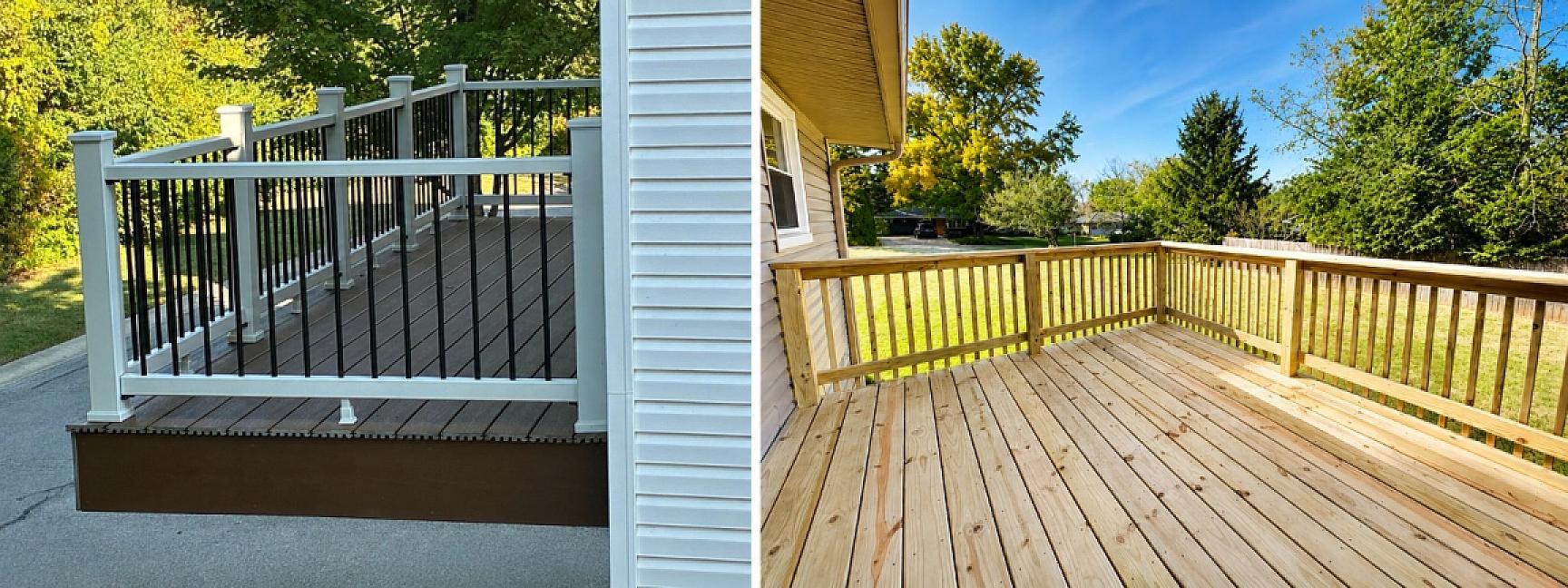
Wood or Composite Decking: Which Is Best for Your Project?
Choosing the material for your deck boards is one of the most important decisions in the project. Pressure-treated wood and composite decking are two popular options, but each offers different benefits.
There is no perfect material for every homeowner. The decision will depend on the initial cost, the desired appearance, the amount of maintenance you are willing to perform, and how the deck will be used.
“What to Consider When Choosing a Material.”
*Wood: Natural Appearance and Versatility.
Pressure-treated wood remains a common option for deck construction. Its natural appearance complements different home styles and can be customized with stains or coatings in a variety of colors.
Wood generally requires a lower initial investment than composite decking. This can be important for homeowners who want to create a functional outdoor space without significantly increasing the project budget.
It also allows individual boards to be replaced and its appearance to be refreshed through cleaning, sanding, and the application of a new finish.
However, exposure to sunlight, rain, and temperature changes can affect its condition over time. For this reason, wood requires periodic cleaning and maintenance, as well as the application of stain or sealer when needed.
This does not mean that wood is an inferior option. It simply requires the homeowner to be willing to include these tasks as part of the home’s regular maintenance.
*Composite: Lower Maintenance and a Variety of Finishes.
Composite decking offers a uniform surface and is available in different colors, textures, and quality levels. Some products are designed to replicate the appearance of wood, while others have a more modern finish.
One of its main advantages is that it generally requires less maintenance. It does not need to be sanded or stained periodically, although it should still be cleaned to prevent the buildup of dirt, debris, or stains.
Its initial cost is usually higher than that of wood. For some homeowners, this difference may be justified by the reduction in certain maintenance tasks over the following years.
Factors such as sun exposure should also be considered. Some boards, especially darker-colored ones, may become hotter. In addition, available product lines and colors may change over time, which could make it difficult to find an exact match for a future repair.
Composite decking requires less maintenance, but it should not be considered completely maintenance-free.
*Initial Cost Is Not the Only Factor.
When comparing both materials, it is important to consider more than just the installation price.
Wood may reduce the initial investment, but it will typically require maintenance products and labor in the future. Composite usually costs more upfront, but it may reduce some of those maintenance tasks.
The way the space will be used should also be considered. A small access deck may have different needs than a large deck used for gatherings, outdoor furniture, or family activities.
Appearance is equally important. Some people prefer the natural grain and variations of wood, while others prefer the uniform look of composite. Reviewing physical samples in natural light can help you visualize how they will coordinate with the siding, doors, and other elements of the home.
*Proper Installation Remains Essential.
The decking material is only one part of the deck.
The safety and durability of the project also depend on the framing, footings, posts, beams, joists, connections, and proper water management.
When only the boards of an existing deck are being replaced, the structure should be inspected first. Installing new material over deteriorated framing does not address the problems that may exist beneath the surface.
Proper installation is important regardless of whether wood or composite decking is selected.
How Do You Make the Decision?
Before selecting a material, it is helpful to ask:
*What is the available budget?
*How much maintenance are you willing to perform?
*Do you prefer a natural or uniform appearance?
*How much direct sunlight will the deck receive?
*How will the space be used?
*Will a new structure be built, or will an existing one be reused?
-Wood and composite decking can both be good options. The best choice will depend on the budget, the desired appearance, and the amount of maintenance the homeowner is willing to perform.-
-laptop_thumbnail.jpg)
-laptop_thumbnail.jpg)




-laptop_thumbnail.jpg)

0 Comments